

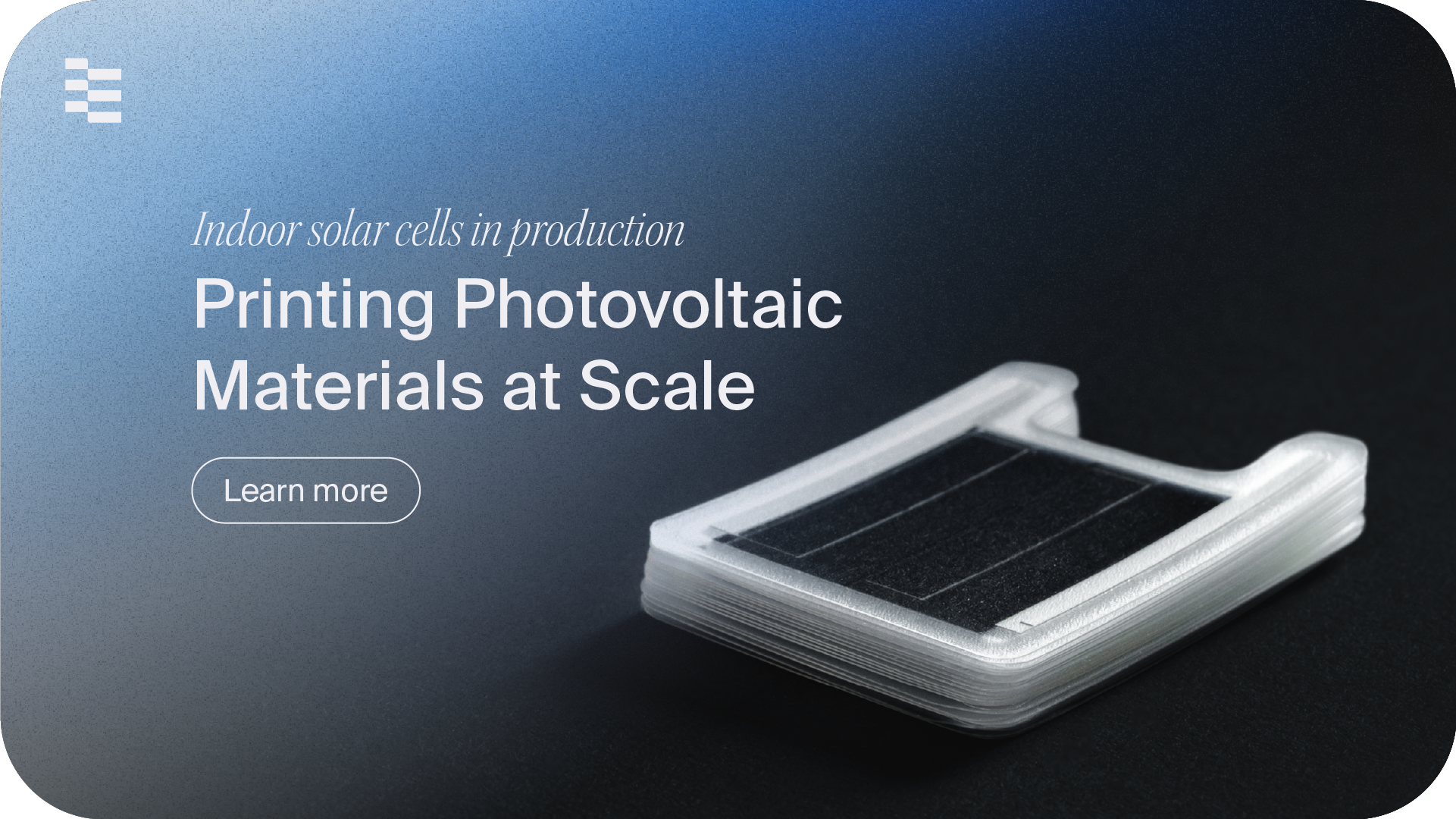
Printing Photovoltaic Materials at Scale
Solar cells for indoor use have been around for decades. Many remember the calculators that worked best close to a window. But as with most technologies, significant progress has been made since then. Early indoor solar solutions were based on silicon—essentially outdoor solar technology placed in indoor environments. Unsurprisingly, performance was limited. Capturing light energy indoors requires a fundamentally different approach. At Epishine, this is where we excel.
Performance in low-light conditions starts at the material level. But making indoor solar cells viable at scale requires more than materials alone. It demands that materials, processes, and manufacturing work together as one integrated system.
Proprietary Material Stack
This composition has important implications for both sustainability and manufacuring. The predominant use of PET means that much of the production process is centered around handling and processing flexible films. By combining optimized materials with a carefully designed layer architecture, we create solar cells specifically engineered for indoor lighting conditions. At the same time, our expertise in roll-to-roll processing of PET foil is a key enabler for scalable, reliable, and cost-efficient manufacturing.
Printing Power Roll-to-Roll
At the core of our production is roll-to-roll (R2R) manufacturing—a process where functional layers are printed onto a flexible substrate that moves continuously from one roll to another. This approach is widely used in printed flexible electronics.
Instead of producing solar cells in discrete, sheet-based steps, R2R enables continuous production—more like a printing press than a traditional factory line. Our roll-to-roll process is designed for our materials and supported by custom-built equipment, allowing us to manufacture flexible, organic photovoltaic cells efficiently and at scale, while maintaining consistent quality.
R2R manufacturing also enables delivery of indoor solar cells on rolls, simplifying the next steps in the customer’s integration process for light energy harvesting applications.
Quality Assurance
Quality is not an afterthought—it is built into every step of our production process.
Before they even enter our production, we begin testing our raw materials. Throughout manufacturing, we perform inline quality controls, electrical performance testing, and reliability testing under varying conditions such as temperature, humidity, and light intensity. Each step is carefully monitored to ensure it meets our standards.
Every cell is tested to verify that it delivers the output and reliability our customers expect.
Read more about our testing procedures in our datasheet.
One integrated system
From custom photovoltaic materials to high-throughput manufacturing, every step is designed to work together as one integrated system. That is how Epishine enables light energy harvesting at industrial scale.