

Why Roll-to-Roll Manufacturing Changes Everything for Indoor Solar Cells
Most people think of solar cells as rigid, fragile, and expensive to produce. Epishine's indoor solar cells are none of those things, and it starts with how they're made.
At Epishine, we manufacture our indoor solar cells using a process called roll-to-roll (R2R) printing. It's the same fundamental principle behind newspaper printing or RFID label production: a flexible substrate moves continuously from one roll to another, with functional layers applied along the way. The result is not just a better manufacturing method. It's a fundamentally different way of thinking about what indoor photovoltaics can be and who can access them.
Here's why it matters.
The Problem with Traditional Solar Cell Manufacturing
Most photovoltaic manufacturing today is sheet-based. Materials are processed in separate batches, with stops between production steps, manual handling between stations, and downtime built into the workflow.
For traditional solar panels, this approach has worked well for decades. But powering hundreds of thousands of wireless sensors, electronic shelf labels, remote controls, smart building devices, or asset trackers is a completely different challenge. These products require an energy source that can be manufactured efficiently, integrated automatically, and delivered with consistent quality across very large volumes. Batch production quickly becomes a bottleneck. It can't scale without multiplying cost, complexity, and waste.
The indoor IoT market doesn't need a boutique energy component. It needs an infrastructure material: something that can be produced reliably, at high volume, with consistent quality. Roll-to-roll manufacturing is the answer to that problem.
What Makes Roll-to-Roll Processing Different
Unlike sheet-based manufacturing, Epishine's printing process is continuous.
R2R manufacturing is practically a non-stop process. The substrate moves steadily through the line, with each functional layer applied in sequence. This continuous flow reduces downtime and minimizes handling damage associated with sheet-based approaches. The result is a process designed for consistency just as much as for speed.
Built for Industrial Scale
Roll-to-roll manufacturing supports very high production speeds, leveraging processing methods that have been refined over more than a century in label printing and over a decade in flexible printed electronics. Epishine's R2R line can produce large volumes of indoor solar cells efficiently, the kind of output that makes fleet-scale IoT deployment not just possible, but economically viable.
Exceptional Material Efficiency
One of the most remarkable aspects of Epishine's manufacturing process is how little active material is required. Just 1 gram of active semiconductor material can produce several square metres of solar cell surface. That's not a rounding error; it's a reflection of how precisely R2R deposition works. Thin, consistent functional layers mean less waste, lower material cost, and a manufacturing footprint that's a fraction of what conventional solar production requires.
Delivered on Rolls, Not as Rigid Units
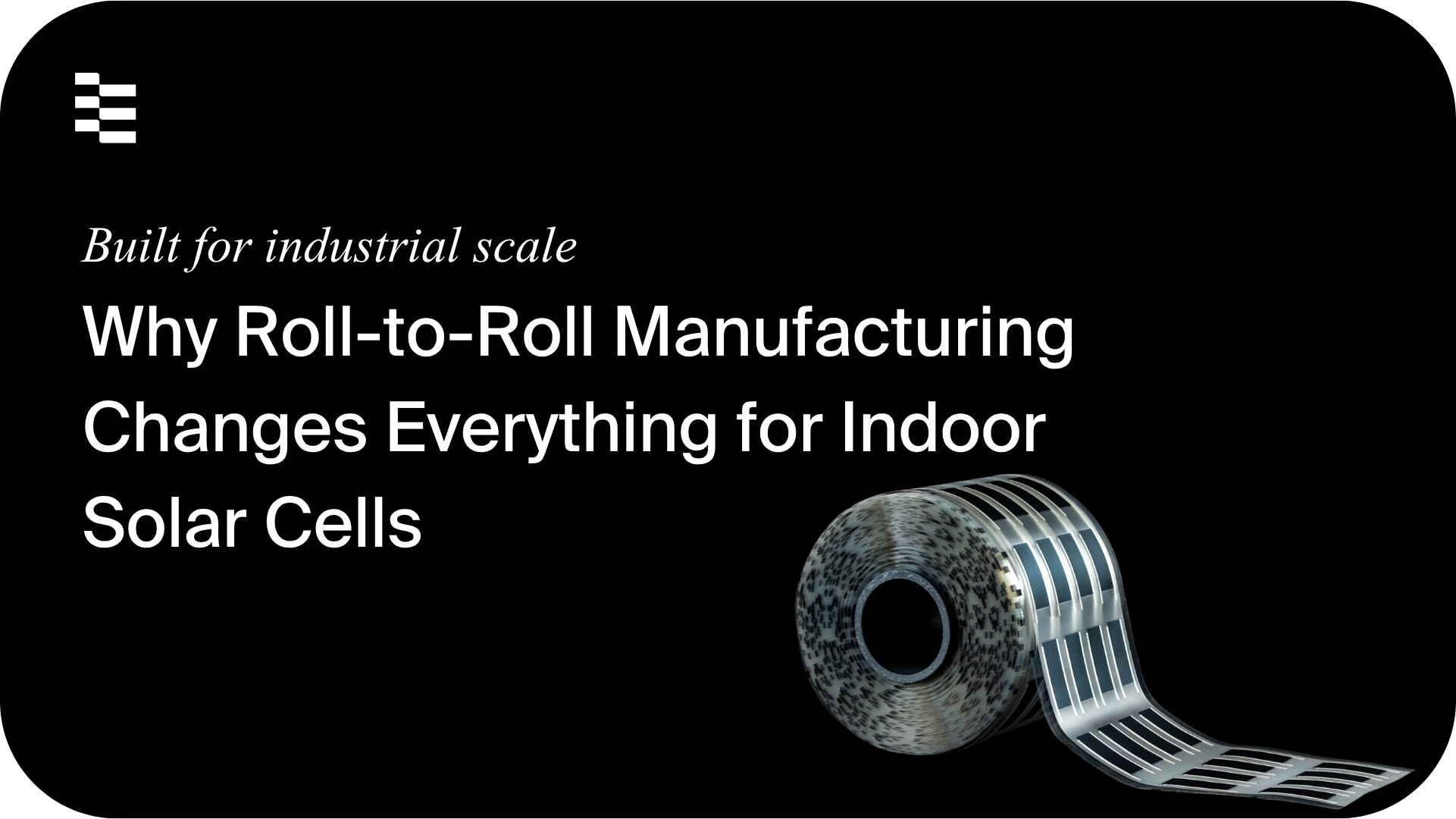
Because the substrate is flexible throughout production, the finished cells can be delivered on rolls, just like the material came in. For OEM engineers and product designers, this is a practical advantage: the cells integrate naturally into automated assembly lines, eliminate the fragility issues of rigid components, and simplify storage and logistics. Integration becomes a design choice, not an engineering challenge.
Quality That Scales
R2R isn't just fast; it's precise. Inline alignment and coating controls ensure consistent layer deposition across every metre of substrate. Epishine's proprietary lamination process, developed specifically for our material stack, eliminates internal short-circuiting and maintains reliable performance in low-light indoor conditions. This is how you achieve quality not just in the lab, but across thousands of units in the field.
Why Manufacturing Matters for Your Product
If you're designing an indoor device, whether it's a wireless sensor, smart label, or asset tracker, you're making decisions today that will affect your total cost of ownership for the next ten years. Battery-powered devices need maintenance. They need replacement cycles. They need service teams, logistics, and disposal processes.
Epishine's light energy harvesting technology, powered by indoor photovoltaics and manufactured at scale through roll-to-roll printing, removes that dependency. Devices powered by ambient indoor light run continuously. They don't need battery replacements. They don't generate battery waste. They simply work, quietly, reliably, across fleets of hundreds or thousands of units.
Without scalable manufacturing, those benefits would remain limited to prototypes. With it, they become commercially viable.
A Manufacturing Platform Built Over Years
Building a roll-to-roll production line for organic photovoltaics is not a simple undertaking. Epishine has developed custom-built industrial machines, engineered specifically for our proprietary materials and process requirements. The machines, the material stack, the lamination process, and the quality controls are the result of years of development. They cannot easily be replicated.
This means that when customers work with Epishine, they're not just buying a component. They're accessing a production infrastructure built for scale, one that has been developed with a clear purpose: to make indoor light energy harvesting the reliable, standard power source for the world's indoor device fleets.
From Linköping to Your Assembly Line
Every Epishine indoor solar cell is manufactured in Linköping, Sweden. From there, the material is shipped on rolls, ready for integration into automated production lines around the world. Whether you're building your first prototype or planning your 50,000th unit, the same manufacturing infrastructure supports you.
The technology is proven. The process is running. And the problem it solves, how to reliably, cost-efficiently power indoor electronics at scale, isn't going away. If your device lives indoors, there's a better way to power it.
Want to learn more? Contact us