

Digitalization is changing how we interact with the world. Where we once relied on electronic devices to manually enter information, connected devices can now collect data directly from their surroundings, with AI helping us make sense of it.
As more of the physical world becomes connected, the question of how to power it all becomes increasingly important. While batteries have made electronics wireless, powering billions of connected devices brings challenges in maintenance, cost, and waste.
So, how do we power the Internet of Trillions of Things?
This was the question explored by Niklas Forsgren from Epishine, Klas Engström from Nichicon, and Safija Palme from EM Microelectronic at The Things Conference, as they discussed how energy harvesting, energy storage, and low-power electronics are opening up new possibilities for connected devices.
A Different Way to Power Connected Devices
Light energy harvesting offers a different way to power connected devices. Instead of relying solely on a battery with a limited amount of stored energy, devices can continuously collect energy from the ambient light around them.
But capturing light is only one part of the solution. A connected device still needs energy to sense, process information, and communicate, while indoor lighting conditions can vary throughout the day.
For light energy harvesting to work reliably, the entire system needs to be designed around the device's energy requirements. The solar cell captures energy from light, power management controls how that energy is used, energy storage provides power when light is insufficient or demand increases, and low-power electronics minimize consumption.
It is how these components work together that determines how efficiently and reliably a device can operate.
Light Energy Harvesting Use Case: Powering an IoT Device at 50 Lux
How much energy can an IoT device actually harvest from indoor light, and what can it do with it?
At The Things Conference, Epishine, EM Microelectronic, and Nichicon presented an example using just 50 lux of available light, comparable to a very dimly lit room (Learn more about lux levels here).
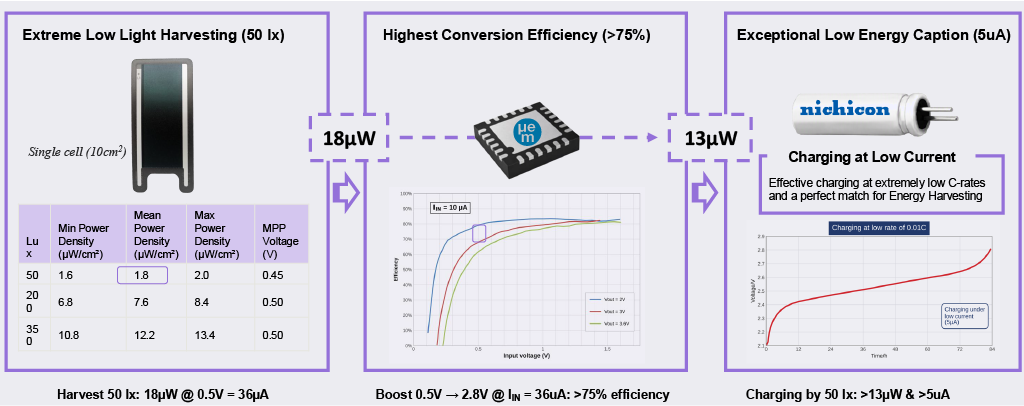
At this light level, a 10 cm² Epishine indoor solar cell generates approximately 18 µW. After passing through EM Microelectronic's power management system, operating at over 75% efficiency, around 13 µW remains available to charge Nichicon's rechargeable LTO cell.
But what can you actually power with that amount of energy?
A typical Bluetooth Low Energy (BLE) transmission in the presented example consumes approximately 0.1 µWh. With ten hours of light per day, the system can harvest around 130 µWh, enough to balance the energy consumption of a device operating 24/7 with approximately 1 µA standby current and a BLE transmission every two minutes.
The result is an energy-balanced IoT device that can continue operating without regular battery replacement, even in very low indoor light conditions.
Optimizing Light Energy Harvesting for Your Application
Every application has different requirements. Available light, communication frequency, standby consumption, and peak power demands all influence how the system should be designed.
By combining their expertise in indoor solar cells, power management, energy storage, and ultra-low-power electronics, Epishine, EM Microelectronic, and Nichicon offer developers a starting point for building reliable, energy-autonomous devices.
Rather than having to evaluate each component separately, developers can build on technologies already demonstrated to work together, reducing development complexity and helping optimize the system for their specific application.
Developing a low-power wireless device? Get in touch to explore how light energy harvesting could work for your product.
Have you considered what the new EU Battery Regulation could mean for your product design?
With new requirements taking effect in 2027, battery removability and replaceability are becoming important considerations for product developers. We'll be sharing more insights on what these changes could mean and how light energy harvesting fits into the picture.