

Light Energy Harvesting: Powering a Connected World
Many of us can hardly remember how we lived before today’s hyperconnected world. The internet has enabled a reality where information flows seamlessly. Lights turn on as you enter a room; your smartwatch gives insights into how you’re doing; and your ring tracks how well you’ve slept. These everyday moments have shaped the Internet of Things (IoT) as we know it. And it’s not about to stop.
As the number of connected devices continues to grow — expected to reach 39 billion by 2030 according to IoT Analytics’ State of IoT 2025 report — the question is no longer about connectivity, it is about power.
How do we power a future where billions of connected devices operate efficiently, reliably, and sustainably?
As electronics become smaller, more distributed, and increasingly autonomous, traditional power solutions start to show their limitations. Batteries—long considered the default—are difficult to scale sustainably due to maintenance needs, limited lifetimes, and replacement logistics.
At the same time, the global energy landscape is undergoing a fundamental shift. Energy production is moving away from centralized, fossil-based systems toward decentralized and renewable alternatives. This transition creates space for technologies that support autonomy and reduce ongoing resource use.
Energy Harvesting as an Enabling Technology
Even if we might not realize it, ambient energy is present almost everywhere in our surrounding environment in the form of light, heat, motion, or radio waves. Energy harvesting turns this ambient energy into usable power, enabling indoor low-power electronics to operate autonomously without disposable batteries or wired connections.
Energy harvesting supports both energy efficiency and system autonomy, two key pillars in the transition towards a more sustainable energy ecosystem. The choice of energy harvesting method depends on the specific application and the environment in which the device is used.
Ambient light as a power source for electronics
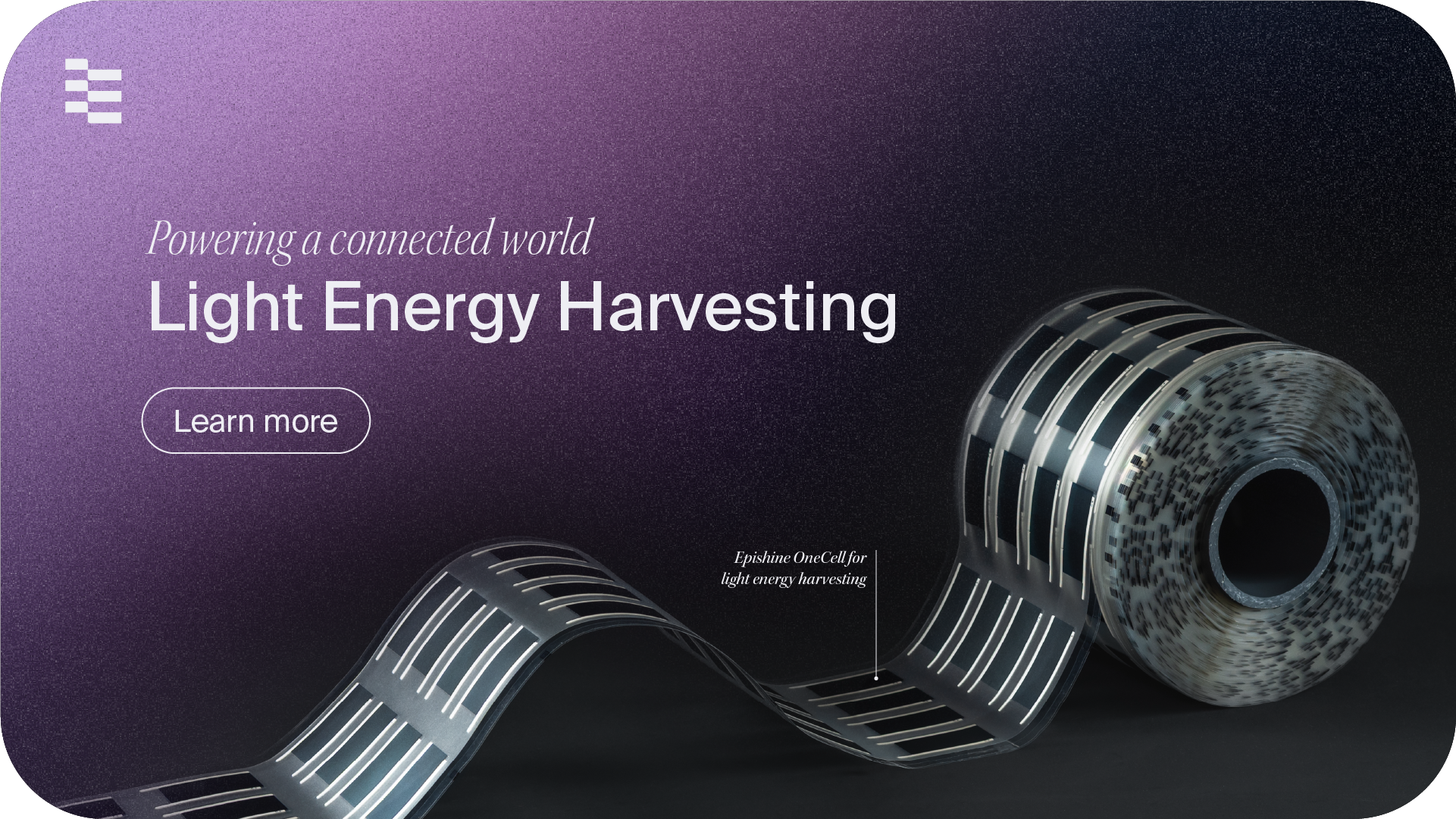
At Epishine, we’ve developed a way to capture ambient light with small, flexible indoor solar cells that convert light into power — a technology known as light energy harvesting. When integrated into low-power wireless electronics such as remote controls, IoT sensors, asset trackers, electronic shelf labels, displays, mice, and keyboards, it enables devices to operate without disposable batteries or wired infrastructure. Because these devices can operate autonomously, the data they generate can help optimize energy consumption and support more efficient operation over time.
Wherever indoor electronics exist, light does too. That makes light energy harvesting a scalable power approach for low-power wireless electronics — from single devices to billions.
Learn more about our indoor light energy harvesting technology.